
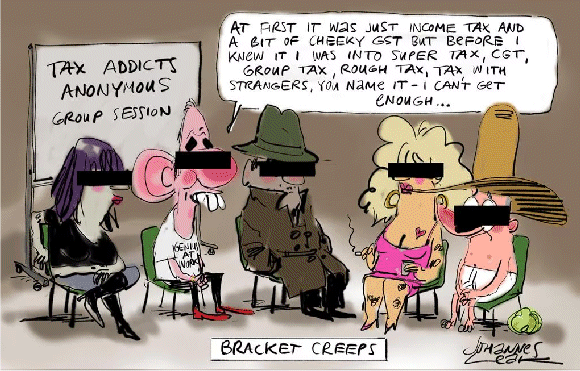
Women who have started successful businesses have lashed the government for painting budget critics as "tax avoiders", arguing Jim Chalmers has never owned a small business and fails to "understand" the impact of his reforms. A group of 10 female business founders launched the latest high-profile campaign against the capital gains tax reform on Thursday, issuing a joint statement to the government after more than 40 entrepreneurs under 40 called for Anthony Albanese to rethink the CGT overhaul in an open letter published this week. The Prime Minister has largely brushed off backlash from the business sector as "misinformation" from people who are unhappy with their loss of tax advantages, while the Treasurer accused political rivals of using the fallout to run "scare campaigns built on lies". Yootopia co-founder Erica Stewart put her name to the statement and called the CGT reforms a "money grab" as she prepares to launch her new AI-powered digital storefront business next month. The tech entrepreneur was one of the 10 women who called for the government to pause and reconsider the reforms as it prepares to push the legislation through parliament next week. "I started a business from scratch, raised a family while doing it, paid myself below the market rate and the characterisation that there are tax avoiders out there is completely out of touch," Ms Stewart said. "I'm in exactly the position that these changes affect, I'm trying to attract great people and offering equity, because I can't always compete on salary. We're not asking for a free pass, but we are asking the government to consult properly with small business owners, female founders, and just get it right." — Elizabeth Pike The Australian today.
Tough night on the field and soccer prize night
Last night’s games were more of a battle than sport. In the NRL the Dolphins scraped past the Raiders 30-22 on the Raiders home turf while in the AFL Hawthorn kept Adelaide at bay 75-66. [click to read more]
Erin Smith in the Oz reveals when Isabel Gomez got an invite to the A-League’s awards night she had no idea what she had been nominated for — she certainly never thought it would be for the prestigious Julie Dolan Medal.
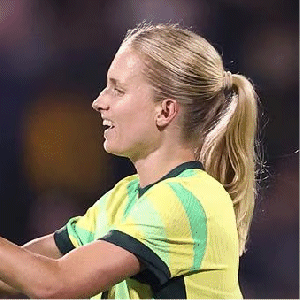
The Central Coast Mariners midfielder said she started to put it together as the ceremony progressed.
It was a real big shock,
Gomez said.
I started to realise when all the players started to get up and I was the only player not with an award, I was super excited and it was such a proud moment.
Her parents were also in attendance at the award ceremony.
While reigning champions Mariners struggled to find consistency on the field this season Gomez did not.
The 23-year-old finished the season with four assists, equal second in the league and four goals.
She was also named in the Professional Footballer’s Australia Team of the Season.
On the 'mere males' side, despite his joy at being named the A-League’s best player, Mata’s preference would have been team success with Victory.
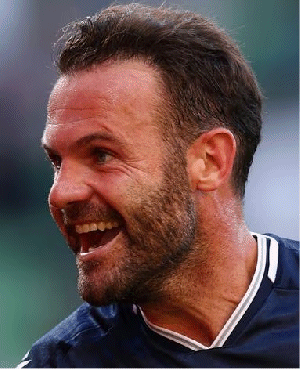
However, after finishing fourth on the table, the Melbourne club was knocked out in week one of the finals series by a Sydney FC side that has gone on to secure a grand-final date this Saturday night with Auckland FC at Go Media Stadium.
Evergreen Spaniard Juan Mata remains undecided about his playing future but will be forever grateful to Melbourne Victory for giving him the chance to show he is still a great player.
Not valued by Western Sydney, Mata switched to Victory for the 2025-26 season, with his dominance securing him the A-League’s highest individual honour, the Johnny Warren Medal.
I felt that Victory was the right place to for me to go and play my football,
the 38-year-old former Manchester United and Chelsea playmaker said in reflecting on a superb campaign that included five goals and a competition-high 13 assists.
When I enjoy playing football I think I can play at my best level, and every week I was looking forward to games and training. and that tells you something about it.
Forget earnings, attention is now back to Iran
Wall Street's benchmark S&P 500 index closed slightly higher after Thursday's choppy session as oil prices finished lower and investors hoped for a Middle East peace deal even as the U.S. and Iran appeared to take directly opposing stances over Tehran's uranium stockpile and control of the Strait of Hormuz, Reuters reports on today's website. [click to continue reading]
After spending the morning in the red, stocks clawed their way back to gains in afternoon trading while oil prices shifted from a rally to a decline as investors monitored social media for news on the peace progress.
While U.S. Secretary of State Marco Rubio told reporters there had been some good signs
in talks with Iran, he also said a diplomatic deal between the U.S. and Iran would be unfeasible if Tehran implemented a tolling system in the Strait of Hormuz, which is a key conduit for oil transportation.
Earlier on Thursday, a Reuters report signaled a hardening stance from Tehran with Supreme Leader Ayatollah Mojtaba Khamenei issuing a directive that the uranium should not be sent abroad. However, President Donald Trump said the U.S. will eventually recover Iran’s stockpile of highly enriched uranium — which Washington believes is destined for a nuclear weapon though Tehran says it is intended purely for peaceful purposes.
Jason Pride, chief of investment strategy and research at Glenmede, attributed volatility during Thursday’s session to investor reactions to speculation about geopolitics.
We're sitting at high levels of valuation partly driven by earnings,
said Pride. That overshadowed the concerns around Iran but now earnings season is largely over. We're not going to suddenly get any more good surprises out of earnings, which means that market attention is now back to Iran. The market, on a near-term basis, is going to be finding its way based on rumors or actual announced deals regarding Iran.
According to preliminary data, the S&P 500 gained 11.54 points, or 0.16%, to end at 7,444.51 points, while the Nasdaq Composite gained 25.82 points, or 0.09%, to 26,296.18. The Dow Jones Industrial Average rose 278.91 points, or 0.56%, to 50,288.26.
The silver lining is that from a market perspective, the fragile ceasefire is still holding. It’s positive there’s still, according to news reports, the possibility of an off-ramp. Oil and market sentiment is very sensitive to every headline,
said Marc Dizard, chief investment officer at Huntington Wealth Management. He added, however: Nobody knows, except the inner circle in Iran and in the U.S., how much progress is truly being made.
Investors were also reacting to the latest batch of earnings from big U.S. companies. Walmart shares tumbled after the largest global retailer forecast second-quarter profit below estimates and maintained its annual targets. CFO John David Rainey said consumers were feeling pressure from high fuel prices and that if elevated cost environment persists, we'd expect somewhat higher retail price inflation in Q2 and the second half of the year.
Among the S&P 500’s 11 major industry sectors, consumer staples led losses as they were weighed down by Walmart’s fall along with declines in some other retailers that fell in sympathy, including Casey’s General Stores and Costco Wholesale.
Shares of Nvidia, the world’s most valuable company, fell as some investors took profits after the AI heavyweight’s upbeat second-quarter revenue forecast and $80 billion share-repurchase program. Its stock has gained sharply so far this year but the pace of growth has slowed as investors believe Nvidia will face tougher competition from chip rivals including Intel and Advanced Micro Devices going forward.
In economic data, jobless claims fell last week, pointing to continued labor market resilience, giving the U.S. Federal Reserve room to keep its focus on inflation risks.
U.S. manufacturing activity rose to a four-year high in May as businesses built inventories to guard against potential shortages and rising prices tied to the Iran war.
Among other movers, IBM rose on news that the Trump administration will fund a handful of quantum computing companies, including a new IBM venture, in exchange for stakes in some of the firms.
GlobalFoundries also climbed along with D-Wave Quantum, Rigetti Computing and Infleqtion.
Intuit’s shares plunged after the software maker lowered the annual revenue forecast for its tax-filing software, TurboTax, and said it would cut 17% of its full-time workforce.
NEWS:
🏴
Albo
rethinks
death tax
Labor is considering a rethink on contentious budget changes to how discretionary testamentary trusts are taxed, dubbed a 'death tax' by critics, reports The Australian today's website.
[click to read more]
The Albanese government is reportedly open to reversing or amending its move to include discretionary testamentary trusts in its minimum 30 per cent tax on discretionary trusts, Labor sources have told the Sydney Morning Herald.
A testamentary trust can only be established via a deceased person’s will: a discretionary testamentary trust puts distributions in the hands of a nominated trustee while a fixed testamentary trust has the distributions pre-ordained.
Under the budget changes, only fixed testamentary trusts were to be excluded from the new 30% minimum tax rate.
Discretionary testamentary trusts are often used by families to protect assets from a child’s partner who may claim half an inheritance, or when parents die before a child is old enough to manage an inheritance as well as to ensure the financial future of a disabled child.
Financial advisers say the decision to hike taxes on future testamentary discretionary trusts would force Australians to reconsider their wills.
The surprise budget move was also a rare departure from the tax agenda Bill Shorten took to the 2016 and 2019 elections that has since been largely mimicked by Anthony Albanese and Jim Chalmers, with all testamentary trusts exempted from the former Labor leader’s policy.
Opposition Treasury spokesman Tim Wilson has said Labor was implementing a stealth death tax
.
The biggest casualty of this budget is the truth, and their backtracking on taxing trusts suggests the government doesn't understand their new taxes, including their stealth death tax,'
he said.
There were 10,516 testamentary trusts in the 2022-23 tax data.
The SMH quotes the Labor source saying the PM will ignore an outcry from small business and push ahead with its remodelling of capital gains tax.
LOCAL CHATTER:
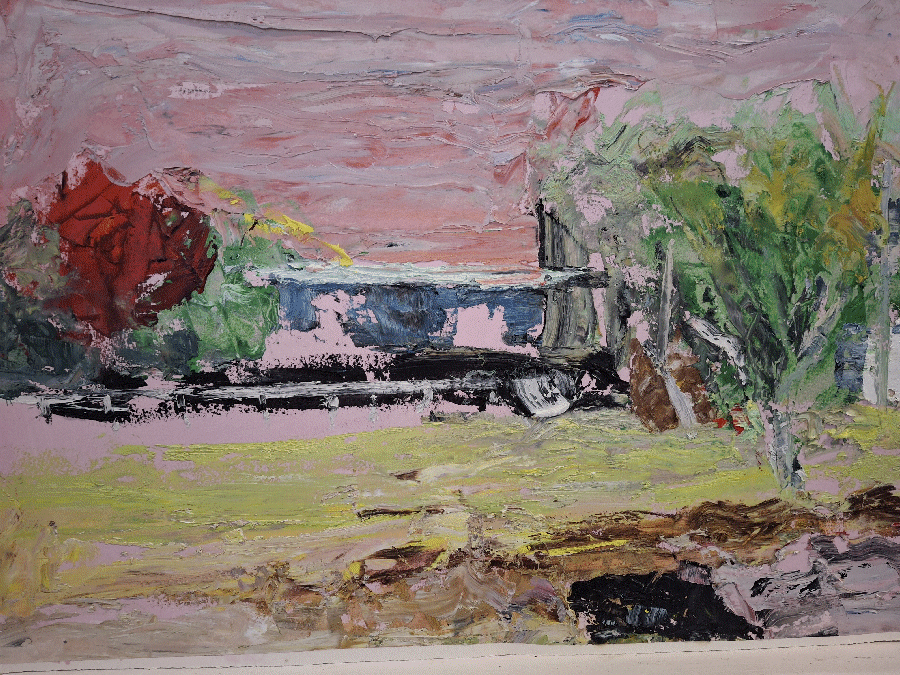 Jelle van den Berg and his Man Mountain exhibition (sample above) is on in God's Waiting Room (the church hall) alongside the museum. This is the last weekend to see his works — it will be taken down during next week.
♦♦♦♦
The Maverick girls footballers are on at home this weekend on Saturday afternoon on Wilson Memorial Oval.
♦♦♦♦
A red-bellied black snake was found in a wall cavity near an operating theatre at John Hunter Hospital recently. It was found in a store room, where surgical supplies like sutures were kept. One hospital staffer said the snake had been sighted for three days before it was caught. Another staffer said the snake catcher had several attempts and eventually had to cut out part of a wall in a storage area. No one knew how it got in.
the Newcastle Herald reports.
NEWS:
🛫
It's all
right for
some …
Veterans Affairs Minister Matt Keogh has spent $2881 flying his wife to Sydney while axing the annual travel budget for a Victoria Cross recipient’s parents, the Daily Telegraph newspaper reports today.
He spent more for a single luxury return trip for his wife than the original annual travel allowance he scrapped for the grieving parents of a war hero.
Mr Keogh claimed $2881.40 in taxpayer-funded travel expenses to fly wife Annabel to Sydney for the LGBTI Military Pride Ball at Crown Barangaroo on October 18, followed by a further $2909.55 for her return flight to Perth the next day.
The trip, which also cost taxpayers $518 for a hotel room and almost $300 for government cars, has been condemned as tone deaf
in the wake of Mr Keogh’s decision to axe the allowance to the parents of Victoria Cross recipient Corporal Cameron Baird, who died on operation in Afghanistan.
Next month, the novel
annual payment to Doug and Kaye Baird to allow them to travel and talk to veterans about their son’s service will be axed.
It was set up under the Abbott government to be about half the Victoria Cross recipient’s allowance of $5696 but is understood to have exceeded that in some years.
Mr Keogh last night announced the Albanese government would commission an independent review of the entitlements but his department refused to confirm exactly how much the Bairds spent on travel every year.
Mr Baird said he never received cash for the flights but claimed them from the Department of Veterans' Affairs.
I would simply receive a request from an organisation, then I'd pass it to the DVA for approval and they would book the flights,
he said.
Stockbroker Angus Aitken has now stepped forward and pledged $20,000 a year to cover the Bairds' travel.
[click the intro to return other stories]

🏠
Investor
need to drop
aspirations
From a five-bed, three-bath McMansion to a two-bed tin roof shack — Aussie investors are facing a harsh new reality as negative gearing changes kick in, reports the news.com.au website today. [click to read more]
As lenders continue to digest the impact of last Tuesday’s federal budget changes which will axe the popular tax break for established homes, mortgage brokers and investors are still largely in the dark on what it will mean for their property aspirations.
On Monday, the nation’s fifth-largest lender Macquarie Group was the first to announce it would no longer be factoring negative gearing into its loan serviceability assessments as of budget night onwards. Westpac, the third-largest lender, notified brokers on Tuesday that similar changes were coming. CommBank, NAB, ANZ and ING are still working through the details but are yet to make any announcements.
Brokers estimate the changes will reduce borrowing capacity by around 10-20%, although none of the banks have yet shared updated serviceability calculators.
Adelaide-based mortgage broker Nathan Gillard from Pathway Mortgage & Finance has crunched the numbers himself, modelling the borrowing capacity impact across 32 scenarios covering single and couple borrowers at varying loan sizes.
By his calculations, borrowing capacity could fall by up to 40% if all add-backs are stripped out — that is, if lenders go further than the negative gearing changes announced in the budget.
It’s [up to] 40% with lenders stripping out all the add-backs, which is not what’s actually being applied,
he told news.com.au.
If lenders take the correct
approach, factoring in deductible interest capped at rental income with the excess quarantined and carried forward — the average change is around 10%.
Correct post-budget treatment reduces borrowing capacity by an average of -10.4% ($106,281) across all scenarios,
Mr Gillard writes.
The percentage impact is remarkably consistent ∼ correct treatment sits between -14.1% and -7.2% regardless of loan size or household type. Blanket removal reduces borrowing capacity by an average of -29.8% ($302,969) ∼ roughly three times the correct impact.
Mr Gillard noted the gap between the two approaches averages $196,688 per borrower, representing capacity lost purely from lender policy choice, not from the legislation itself
, which is yet to be passed.
Lender selection has become a material financial decision for anyone purchasing an investment property,
he writes.
Under the existing rules, losses from a rental property can be used to reduce other forms of taxable income such as salary and wages.
Labor argues negative gearing encourages leveraged property investments that can lead to investors receiving greater tax advantages than those available to owner occupiers.
Starting from July 1 next year, negative gearing will be restricted to new builds only, meaning any investors looking to buy established homes face a massive financial hit.
[click the intro to return to front page]
🌟
The problems
of fame
One Nation's rapid national expansion in disarray as 'significant risks' force dissolution of new branches. Documents seen by Guardian Australia also show new branches and members will be subject to strict gag orders writes The Guardian website. [click to read the rest of the story].
The correspondence also shows that the party’s new branches and members will be subject to strict gag orders: all committee members and nominees must sign non-disclosure agreements, while branches must agree to a media silence
policy and a social media ban.
The requirement is understood to have upset some party members, given One Nation has frequently billed itself as the party of free speech. Its policy platform states that the right to free speech should be enshrined in the constitution, saying: One Nation will always stand for your right to speak, debate, and express your views.
One Nation announced it would begin rolling out new branches in every federal electorate in August last year as the engine room of our grassroots movement
, however, branches have since been told that the review uncovered inconsistencies
in their structure that could leave them vulnerable to legal challenge.
We are finding discrepancies and inconstancies including that formal establishment minutes do not exist, were recorded incorrectly, or the processes for establishing a branch and/or electing formal committee roles (co-ordinators, secretaries, and treasurers) were non-compliant or unvetted,
the directive dated 17 April says.
I fully accept that this may not be true for all branches, however the amount of time and resources involved in thoroughly identifying all is more than significant in circumstances where we have an election to win outright.
The letter states that if the party’s documentation was flawed, the very existence of a branch can be legally challenged
.
“Decisions, appointments, and policy contributions made by a committee can be overturned, leaving the party in a position of legal and operational jeopardy.
Given the threat that One Nation presents to the other partes, the risk of this occurring is very real. We cannot ∼ and will not ∼ allow administrative oversights to compromise our movement as we approach the single most critical moment in Australian political history.
Morton says that he has been instructed by the party’s national executive to build a professional, scalable, and legally robust organisation capable of outright victory at the next general election
.
I understand that this requirement will cause some frustration but it is a non-negotiable step toward ensuring that when we win, our victory cannot be taken away from us on an administrative technicality.
[click the intro to return to front page]
COMMENT:
Murrurundi Times news site with items covering national news and Upper Hunter region including the township of Murrurundi
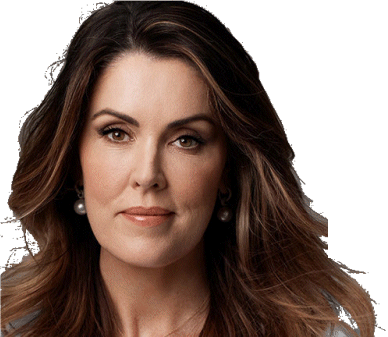
Federal Court has ruled against a women-only app founder in a landmark transgender discrimination case, forcing her to pay compensation and sparking fears about women’s rights, writes Peta Credlin in the Sunday Telegraph today. [click to read more]
On Friday afternoon, as I sat down to work on this column, I honestly didn't know where to focus first.
Was the biggest issue the loss of integrity in our public life, after the Prime Minister ("my word is my bond") admitted saying 50 times he would not change any of the rules around investment properties but did it anyway?
Or was it the reality, confirmed in the budget papers, that under Labor’s record high immigration, Australia will hit 30 million people by 2030, despite nowhere near enough housing for those here now? Or was it the revelation that Labor has just brought in death duties by stealth?
Giggle v Tickle
As I debated all of this, the Federal Court handed down its decision in the long-running Giggle v Tickle case, where Sall Grover, a woman and founder of a women’s online networking app (called Giggle For Girls) was accused of discrimination against a transgender woman, the biologically male Roxanne Tickle, who sought to join the women-only app.
In a devastating blow for the rights of women and girls in this country, the court rejected scientific fact and declared that sex was more than biology (it isn't), and so Grover lost and now owes compensation to Tickle.
The fact that the taxpayer-funded Human Rights Commission was a part of this legal action to deny all women our biological rights is appalling. The fact that Grover now has to rely on donations from ordinary people to defend rights that should not need defending says everything about the state of woke policy and activist courts in Australia.
But what’s perhaps most galling of all is that we are only in this position of denying chromosomal reality because Julia Gillard, ironically the first female prime minister, stripped the word woman
from the sex discrimination act. Before then, this case would never have got to court.
Anyone for any toilet
But what this latest decision does (and let’s hope it gets overturned when Sall Grover heads to the High Court), is that women’s sport, toilets, access to medical services, schools, clubs, domestic violence shelters, prisons ∼ the whole box and dice ∼ are open slather to any man who declares he is a woman.
Gender used to be what you called yourself, sex is what XY or XX made you. Not any more, thanks to this decision. And Gillard too, who changed the law just TWO DAYS before she was rolled by Kevin Rudd in June 2013 — how dare she lecture anyone on misogyny.
But on Friday afternoon, the bad news kept coming.
To add Labor insult to Labor injury, dropped out when they hoped no-one was watching was news from the Victorian government that not only was Daniel Andrews going to get a bronze statue in his honour but that it was already being made. You can't make this stuff up, can you?
In memory of stupidity
Given Victoria has a daily interest bill of $24 million, a $130,000 statue is a rounding-error but it’s the attempt to force Victorians to honour the man who locked them up for two years, ruined businesses, blew out debt, kowtowed to China, dialled up woke and made the once-proud state an international laughing stock that’s tipped people over the edge.
Am I the only one asking how the heck did we get here?
And, more to the point, how do we turn it around or, God forbid, is it even possible?
Never trust any leader again
If Albanese is allowed to get away with his massive budget lie, then we will never be able to trust any leader again. And if we can't ask questions before an election and base our decisions on what they tell us and hold them to it, then democracy is dead.
For all of Labor’s talk about intergenerational equity, the budget hits younger Australians the hardest. The PM says breaking his word on negative gearing is about them, but how can it be when they will never be able to use negatively gearing (as he has) to build up a nest egg but those doing it now can keep it up?
Buy a new-build property instead, Labor tells investors. But again, how’s that fair for young people given this is what they typically buy as a first home and, now, they're going to face even more competition as investors move in? Even Labor’s own budget papers admit that these changes will likely increase rents (as they did in the Keating era before he was forced to back down) and do little to increase the stock of available homes.
And then there’s the tax on aspiration (CGT changes) before they get you from the grave (the hit on trusts).
Liberal backbone
Thankfully, the Liberals have finally found a bit of policy backbone, and a bit of political mongrel.
Angus Taylor’s reply to Labor’s budget speech felt like the start of the Coalition getting its mojo back. He made the bold move to end bracket creep once and for all by indexing income tax thresholds, meaning low- and middle-income earners won't get punished for getting ahead. On migration, he went for the jugular and landed a bullseye if the hyperventilating from Labor MPs is any guide. The PM in particular was hysterical, declaring it was un-Australian to divide people between those who are migrant and those who are not.
That is not what Taylor did. He divided them between Australian citizen and non-citizen and said that, under the Coalition, only citizens would get access to the pension, the dole, the NDIS and other welfare.
Help for no commitment
Now what is unfair about that? Why should your taxes carry people who have made no formal commitment to this country? Right now, people can live here for decades, take the money and never pledge loyalty to Australia and its people. Taylor says not any more.
Add in the Treasurer’s announcement of a new Working Australians Tax Offset (a pollster-named handout if ever there was one) of $250 a year (or $4.80 a week) and rightly people are angry. In his budget speech, Jim Chalmers called his WATO meaningful
but what’s meaningful about 68 cents a day when the cost of everything has skyrocketed? It’s not meaningful, it’s insulting.
(And I might add, it’s still not even the $275 Albanese promised off their power bills).
Albo's right for a change
Anthony Albanese said that this budget is full of Labor values
and it is — the socialist values
that attack the fair-go, break trust, and hit middle Australia even harder
For the Liberals, there could be no better ground than this to fight Labor.
If the Coalition holds its nerve and campaigns every day like its life depends on it (because, frankly, it does) then this budget could well be the beginning of the end for the Albanese government.
But only if they work, day and night, to take the fight up to Labor. Labor is the target, not each other and not One Nation.
THUMBS UP
Jacinta Nampijinpa Price: Her emotional, fighting speech in the Senate is a must-watch as she demanded culture
takes a back seat to better protect Aboriginal children.
THUMBS DOWN
Military witch hunt: Another $43m in Labor’s budget to investigate soldiers on top of the $350m that the Brereton process has cost taxpayers already.
Murrurundi Times news site with items covering national news and Upper Hunter region including the township of Murrurundi

"Promises and pie-crust," Jonathan Swift wrote in 1738, "are made to be broken." Vladimir Lenin, who liked the line, treated it as a slogan. Anthony Albanese treats it as a principle, Henry Ergas points out in the The Australian today. [click to read more]
The Prime Minister’s defence for repudiating assurances he had insistently reiterated ∼ indeed, for the 50th time
∼ is that Australia faces a crisis of intergenerational equity. But as Jonathan Pincus and I demonstrated on these pages, the claim is analytically incoherent and empirically threadbare. Nor, even if there were such inequities, would that justify the abrupt abandonment of repeatedly affirmed undertakings.
Serious governments seek democratic consent for contentious measures they had previously assured voters they would not introduce. John Howard did so with the GST: having ruled it out, he reversed openly, took it to the 1998 election, and proceeded only on the mandate he won there.
Greatest tax take in commonwealth history
The reason the Albanese government has not followed suit is neither urgency nor necessity. It is fear: fear that despite the opposition’s parlous state, voters would punish a government that has spent freely, governed carelessly and is now poised to extract the greatest tax take in commonwealth history.
The budget’s own numbers make the reality plain. Even accepting Treasury’s assumptions, the budget measures will increase housing supply over the next decade by less than one-third of 1%, while housing demand is likely to rise more than 15 times as quickly. This is not serious economic reform. It is a revenue grab wrapped in the language of moral urgency.
Corroding public trust
The inevitable result of that gap between political rhetoric and political practice is to corrode public trust. Trust, after all, is not a natural disposition; it is a social achievement, slowly accumulated and quickly squandered.
The word itself reveals the point. The Old English treow
lies behind both truth
and trust
; since at least the 15th century, to trust
someone has meant to believe that when he says what he will do, he speaks truthfully. Governments can sustain trust only by being truthful and trustworthy — and the institutional form through which those virtues manifest themselves is the promise.
A promise is what binds words to conduct, declarations to action, and electoral consent to subsequent government. Governments owe fidelity to their promises not merely for their own political advantage; they owe it because a healthy democratic life depends upon citizens being able to assume and assess fidelity to public commitments.
Governments need to mean what they say
The credibility of promises is also more broadly crucial to the viability of a free society, whose very essence is that people must order their lives amid continual uncertainty. Promises, including the promise that laws will not be changed capriciously, are what give individuals, families and businesses stable ground on which to plan. As Hannah Arendt wisely observed, they build islands of predictability
in the ocean of uncertainty
— islands that matter most to those with the fewest resources to absorb sudden policy shocks.
A young couple relying on an investment property to finance homeownership, a retiree dependent on hard-earned savings, a small business weighing expansion: all rely on governments meaning what they say.
But promises can only fulfil that stabilising role because they belong to the grammar of commitment: to the forms of obligation whose value lies in their relative insulation from changing convenience. A promise abandoned the moment it becomes burdensome is worth no more than the loyalty that melts away at the first sign of difficulty.
The preservation of credible public commitments is especially vital in Australia, where suspicion of the political process long predates contemporary disenchantment. Distrust of politicians was, as John Hirst emphasised, constitutive of the colonial polity itself. The men who entered politics were not thought fit to be trusted - and despite outstanding exceptions, many weren't.
Pioneering scholars of mass behaviour
The endless Australian debate over the accountability of parliamentarians reflected that suspicion. Both the Burkean trustee ∼ who is guided only by the light of his own judgment ∼ and the instructed delegate had their advocates. But it was the latter conception, entrenched by the emerging Labor Party, that ultimately prevailed. Labor parliamentarians were to be mere instruments: controlled by the ALP’s extra-parliamentary wing, bound by a pledge to uphold the platform and required to submit to caucus discipline on pain of political excommunication.
The Australian mass party thus emerged, from the beginning, as an institutional response to distrust: a mechanism designed less to cultivate confidence in politicians than to contain the risks they posed once elected. And Australian voters learned to scrutinise the distance between promise and performance with an intensity rare in comparable democracies. When that gap widened too far, confidence collapsed.
It is against this background that the events of the past three years must be seen. The Albanese government’s record on the central tax promises of two successive elections ∼ stage three, superannuation, and now negative gearing and the capital gains tax discount ∼ does not just constitute a litany of broken commitments; it constitutes the accelerated dismantling of an already tarnished public asset.
The predictable effect is an even more accelerated crisis of political representation. The four-decade arc from 1975’s 4% third-party vote to 2025’s 34% highlights its seemingly inexorable progression.
Withdrawing faithfulness
Those voters who have spurned the major parties are not ideological partisans of any third force; they are observant citizens who, having grasped what the parties no longer deliver, exercise the only sanction the system leaves them. Unable to meaningfully demand or expect faithfulness to a program from parties whose programs have ceased to bind, they withdraw their own faithfulness from those parties altogether.
The alternatives may not be especially attractive nor particularly unifying — but negative coalitions, aimed at punishing a detested foe, form more easily than positive ones precisely because they require only shared aversion rather than common aspiration. In these conditions, anti-system parties flourish, their capacity to aggregate voters a symptom not of democratic renewal but of democratic exhaustion.
To make things worse, governments confronted by a perpetually seething electorate are naturally tempted to govern through stealth and administrative manoeuvre, further impairing the trust whose disappearance produced the crisis of representation in the first place. And when a real, rather than confected, emergency arrives, they discover they can no longer summon the loyalties and willingness to sacrifice on which the survival of free societies ultimately depends.
Public language becomes tactical
No society can govern itself for long on the assumption that public language is merely tactical. Governments that repeatedly break faith with the electorate may secure temporary advantages. But they do so by undermining the confidence that policies announced today will survive long enough to shape behaviour tomorrow. As that confidence erodes, both the effectiveness of public policy and force of democratic authority unravel.
That is the deeper significance of the Albanese government’s conduct. It is not merely bad policy. It is the depletion of a civic inheritance that free societies squander far more easily than they rebuild. Yes, promises can be cracked like pie crusts. But in the end, public trust cracks with them. Lenin, sheltered by brutal authoritarianism, never had to learn that lesson. With the fabric of our democracy rapidly fraying, it is high time Anthony Albanese did.
FEATURE:
Created by DiDa - http://www.faico.net/dida/
Ω
Some years ago, I was involved in a positive change in Australian sport that has parallels with the issues before the Royal Commission on Antisemitism and Social Cohesion.
Skinning
the
cat!
Frank Lowy in The Australian
T
hrough this change, a form of social cohesion was achieved. I believe this is a concrete example of how ethnic divisiveness was transformed into loyalty to Australia. It shows how social change can take effect and bind a community.
This submission is made in the hope that the commission may find something useful in the method my team and I used to achieve this goal.
I want to emphasise that I am not equating racial aggression in a sports stadium with nationwide antisemitism. The two are not comparable.
Rather, I am sharing the architecture of a cultural shift that took place in soccer, said to be the most popular sport on Earth. In Australia, it is the most popular and fastest-growing sport, with more than 1.9 million participants nationwide, according to Football Australia’s 2024 National Participation Report.
Australians have long loved soccer but historically this failed to translate into professional organisation, largely because of competition from other football codes, poor administration, financial instability and blatant ethnic factionalism.
In the Australia of the 1950s and 1960s, soccer was plagued by ethnic rivalries. It was a period of high migration and every week ethnic teams settled old scores they had imported from countries once at war with one another in Europe.
Winning hearts and minds
Passion was high and rioting was common. Players often needed protection, and in extreme cases — such as supporters running on to the field with iron bars — armed police had to separate the sides. As a code, soccer was fragmented and was not a mainstream sport. Sometimes announcements were in foreign languages and, generally, Australian families tended to stay away.
For decades, serious but unsuccessful attempts were made to de-ethnicise the game. My team finally achieved this because we had the cultural confidence to pull the ethnic factions into the mainstream.
Our success did not come from the use of hard power alone, by forcing change with rules and regulations. Soft power ∼ winning the hearts of the soccer community and inspiring pride in being Australian ∼ was crucial too.
Dislike of Jews
Looking back, I think it may be possible to work respectfully and diligently to bring communities that strongly express antisemitism ∼ and other forms of racism ∼ into the mainstream to share Australian values.
In soccer, we didn't try to take people’s ethnic identity away; we worked to stop the expression of ethnic conflict in public. Similarly, it is probably not possible to eradicate a dislike of Jews, but it is possible to help people understand why, in Australian society, the public outpouring of this aversion is not right.
The social licence that has allowed for the open expression of anti-Jewish sentiment needs to be reworked. If this helps to curb antisemitism, it will likely be useful in curbing other forms of racism in Australia.
While my sons reported some antisemitism during their school days, I encountered very little in my first decades in business. When it did emerge, I confronted it directly and suffered no hardship as a result. Through my leadership positions in the Jewish community, I had a fair idea of the level of antisemitism in the country and it seemed low, although it did occasionally flare.
Openly celebrate massacre
When antisemitism burst on to the forecourt of Sydney’s Opera House on October 9, 2023, I was astonished. Australians were openly celebrating a massacre. Amplified by the powerful engine of social media, a new entitlement had emerged. People seemed not to have understood the privilege of free speech and freely abused it.
From the 1960s through the 1990s, attempts to de-ethnicise the game did not have lasting effect and in 2003, prime minister John Howard asked me to professionalise the sport.
It was dysfunctional and insolvent, with no international presence. For this task, I had several advantages, including:
● Strong government support, funding and leadership;
● In turn, this led to people of high standing with expertise in finance, law, government relations, sports governance, marketing and event management to join me, pro bono, to help;
● In turn, generous sponsorship from big business followed, so did broadcasting deals;
● Early generations of compatriots had passed, leaving children and grandchildren more amenable to change.
Creating a new structure
We needed to create a new structure and rally people to our cause. Rules-based change cannot have the intended impact without wide social and cultural acceptance. The Australian football family had three codes; rugby league, rugby union and Australian rules. We rebranded soccer as "football" and it became the fourth.
Then we began changing the game in three domains:
● In Australia;
● On the international stage;
● Within the global system of football confederations.
As it happened, each change impacted the next, creating a ripple effect.
Previously, in Australia, there had been a push towards replacing ethnic names with regional ones. We built on this and removed all trace of ethnicity for the new top league. There would be eight teams in the A-League, each carrying the name of a major city.
The teams, such as Brisbane Roar and Perth Glory, created their own character and regalia. Each team had players from a mix of backgrounds and were miniature versions of multicultural Australia. Their fans of all ethnicities entered though the same gate.
Wogball vanished
The "wogball" tag vanished and more teams were established. While ethnic affiliations remained in lower leagues, the main league was driven by high-spirited, inter-city tribalism. Acceptance of this increased exponentially as the Socceroos limbered up for the World Cup.
We had not been seen on the international stage for more than 30 years and we focused intensely on preparing them. In 2005, as they inched their way towards qualification, the football community grew increasingly engaged. When the Socceroos qualified, the country went wild.
In turn, this energised our next strategic move. For years, Australia had tried to leave the small Oceania Football Confederation and join the powerful Asian Football Confederation, but its door remained closed. After strong representation, in January 2006, it opened and Australia was welcomed into Asia.
Our world presence improved as did the quality of competition. The cumulative effect of all the changes shifted the perception of Australian football. Its Australian identity was baked in. We had achieved cohesion and professionalised the sport.
At every positive point, we had harnessed the enthusiasm to keep the vision alive. We'd used advertising, marketing, merchandise, celebrity personalities, events, international matches, interviews, media ∼ whatever we could ∼ to embrace and inspire the community.
OVERSEAS:
The London Telegraph writes Britain's economic malaise is deepening and driving away our most talented young people. Adults under 34 are abandoning the country, with net migration at a five-year low. Meanwhile, contenders for the Labour Party's leadership show no sign of stimulating economic growth, with Wes Streeting's support for a wealth tax prompting stark warnings from tech entrepreneurs and AI experts. Elsewhere, five people have been arrested over allegations of fraud linked to the local elections in Tameside according to Chris Evans, editor.  Latest headlines: ♦ How Pokèmon cards became the ultimate currency for money-laundering gangs. The pictured one is worth £12,248,278. ♦ Russians are waking up to the economic catastrophe of Putin's war. ♦ 'I've read 1000 self-help books so you don't have to. Here's what really works'. ♦ Reeves cuts VAT on zoos and theme parks. ♦Assisted dying bill will return, say campaigners. ♦ Investigate pro-Palestine Southbank boss, MPs tell Nandy. ♦ NHS staff sacked over Nottingham attack victims' records and ♦ King proves a hit with ukulele solo.
Created by DiDa - http://www.faico.net/dida/
-

The tik-toks have it
At Milan Design Week, just following Watches and Wonders, Jaeger-LeCoultre staged The Perpetual Timekeeper, a sprawling two-floor exhibition dedicated not to wristwatches, but to Atmos clocks-the mysterious, glass-encased objects that have quietly occupied one of the most intriguing corners of the maison's history since 1928. ROBB Report.
-
Pollocks's $152m sale
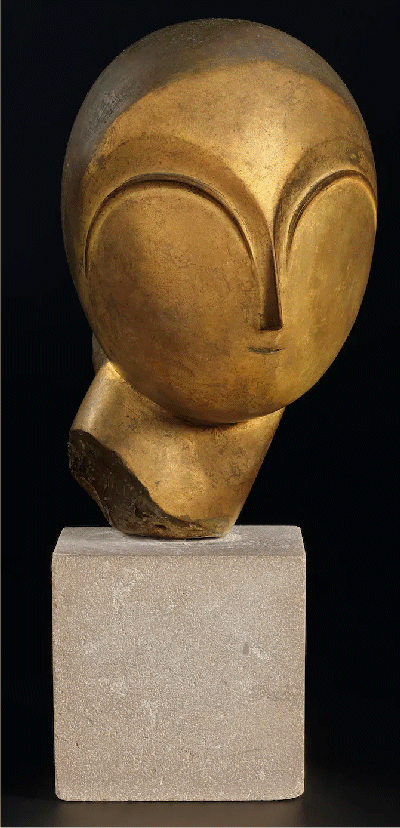
The second-highest price Christie's registered in the Newhouse collection was $107.6 million for Constantin Brâncusi's gilt-bronze bust Danaïde (above), which sold on just one bid. This makes it the second most expensive sculpture ever sold at auction after Alberto Giacometti's $141 million Pointing Man. Newhouse bought the bust in 2002 at Christie's for a then-record $18.2 million. The Jackson Pollock's Number 7A, 1948, was the top seller at $152m.
The Murrurundi Times is owned, compiled and written by Des Dugan. Email
Wall Street's benchmark S&P 500 index closed slightly higher after Thursday's choppy session as oil prices finished lower and investors hoped for a Middle East peace deal even as the U.S. and Iran appeared to take directly opposing stances over Tehran's uranium stockpile and control of the Strait of Hormuz, Reuters reports on today's website. [click to continue reading]
After spending the morning in the red, stocks clawed their way back to gains in afternoon trading while oil prices shifted from a rally to a decline as investors monitored social media for news on the peace progress.
While U.S. Secretary of State Marco Rubio told reporters there had been some good signs
in talks with Iran, he also said a diplomatic deal between the U.S. and Iran would be unfeasible if Tehran implemented a tolling system in the Strait of Hormuz, which is a key conduit for oil transportation.
Earlier on Thursday, a Reuters report signaled a hardening stance from Tehran with Supreme Leader Ayatollah Mojtaba Khamenei issuing a directive that the uranium should not be sent abroad. However, President Donald Trump said the U.S. will eventually recover Iran’s stockpile of highly enriched uranium — which Washington believes is destined for a nuclear weapon though Tehran says it is intended purely for peaceful purposes.
Jason Pride, chief of investment strategy and research at Glenmede, attributed volatility during Thursday’s session to investor reactions to speculation about geopolitics.
We're sitting at high levels of valuation partly driven by earnings,
said Pride. That overshadowed the concerns around Iran but now earnings season is largely over. We're not going to suddenly get any more good surprises out of earnings, which means that market attention is now back to Iran. The market, on a near-term basis, is going to be finding its way based on rumors or actual announced deals regarding Iran.
According to preliminary data, the S&P 500 gained 11.54 points, or 0.16%, to end at 7,444.51 points, while the Nasdaq Composite gained 25.82 points, or 0.09%, to 26,296.18. The Dow Jones Industrial Average rose 278.91 points, or 0.56%, to 50,288.26.
The silver lining is that from a market perspective, the fragile ceasefire is still holding. It’s positive there’s still, according to news reports, the possibility of an off-ramp. Oil and market sentiment is very sensitive to every headline,
said Marc Dizard, chief investment officer at Huntington Wealth Management. He added, however: Nobody knows, except the inner circle in Iran and in the U.S., how much progress is truly being made.
Investors were also reacting to the latest batch of earnings from big U.S. companies. Walmart shares tumbled after the largest global retailer forecast second-quarter profit below estimates and maintained its annual targets. CFO John David Rainey said consumers were feeling pressure from high fuel prices and that if elevated cost environment persists, we'd expect somewhat higher retail price inflation in Q2 and the second half of the year.
Among the S&P 500’s 11 major industry sectors, consumer staples led losses as they were weighed down by Walmart’s fall along with declines in some other retailers that fell in sympathy, including Casey’s General Stores and Costco Wholesale.
Shares of Nvidia, the world’s most valuable company, fell as some investors took profits after the AI heavyweight’s upbeat second-quarter revenue forecast and $80 billion share-repurchase program. Its stock has gained sharply so far this year but the pace of growth has slowed as investors believe Nvidia will face tougher competition from chip rivals including Intel and Advanced Micro Devices going forward.
In economic data, jobless claims fell last week, pointing to continued labor market resilience, giving the U.S. Federal Reserve room to keep its focus on inflation risks.
U.S. manufacturing activity rose to a four-year high in May as businesses built inventories to guard against potential shortages and rising prices tied to the Iran war.
Among other movers, IBM rose on news that the Trump administration will fund a handful of quantum computing companies, including a new IBM venture, in exchange for stakes in some of the firms.
GlobalFoundries also climbed along with D-Wave Quantum, Rigetti Computing and Infleqtion.
Intuit’s shares plunged after the software maker lowered the annual revenue forecast for its tax-filing software, TurboTax, and said it would cut 17% of its full-time workforce.
| 🏴 | Albo rethinks death tax |
Labor is considering a rethink on contentious budget changes to how discretionary testamentary trusts are taxed, dubbed a 'death tax' by critics, reports The Australian today's website. [click to read more]
The Albanese government is reportedly open to reversing or amending its move to include discretionary testamentary trusts in its minimum 30 per cent tax on discretionary trusts, Labor sources have told the Sydney Morning Herald.
A testamentary trust can only be established via a deceased person’s will: a discretionary testamentary trust puts distributions in the hands of a nominated trustee while a fixed testamentary trust has the distributions pre-ordained.
Under the budget changes, only fixed testamentary trusts were to be excluded from the new 30% minimum tax rate.
Discretionary testamentary trusts are often used by families to protect assets from a child’s partner who may claim half an inheritance, or when parents die before a child is old enough to manage an inheritance as well as to ensure the financial future of a disabled child.
Financial advisers say the decision to hike taxes on future testamentary discretionary trusts would force Australians to reconsider their wills.
The surprise budget move was also a rare departure from the tax agenda Bill Shorten took to the 2016 and 2019 elections that has since been largely mimicked by Anthony Albanese and Jim Chalmers, with all testamentary trusts exempted from the former Labor leader’s policy.
Opposition Treasury spokesman Tim Wilson has said Labor was implementing a stealth death tax
.
The biggest casualty of this budget is the truth, and their backtracking on taxing trusts suggests the government doesn't understand their new taxes, including their stealth death tax,'
he said.
There were 10,516 testamentary trusts in the 2022-23 tax data.
The SMH quotes the Labor source saying the PM will ignore an outcry from small business and push ahead with its remodelling of capital gains tax.
♦♦♦♦
The Maverick girls footballers are on at home this weekend on Saturday afternoon on Wilson Memorial Oval.
♦♦♦♦
A red-bellied black snake was found in a wall cavity near an operating theatre at John Hunter Hospital recently. It was found in a store room, where surgical supplies like sutures were kept. One hospital staffer said the snake had been sighted for three days before it was caught. Another staffer said
the snake catcher had several attempts and eventually had to cut out part of a wall in a storage area. No one knew how it got in.the Newcastle Herald reports.
| 🛫 | It's all right for some … |
Veterans Affairs Minister Matt Keogh has spent $2881 flying his wife to Sydney while axing the annual travel budget for a Victoria Cross recipient’s parents, the Daily Telegraph newspaper reports today.
He spent more for a single luxury return trip for his wife than the original annual travel allowance he scrapped for the grieving parents of a war hero.
Mr Keogh claimed $2881.40 in taxpayer-funded travel expenses to fly wife Annabel to Sydney for the LGBTI Military Pride Ball at Crown Barangaroo on October 18, followed by a further $2909.55 for her return flight to Perth the next day.
The trip, which also cost taxpayers $518 for a hotel room and almost $300 for government cars, has been condemned as tone deaf
in the wake of Mr Keogh’s decision to axe the allowance to the parents of Victoria Cross recipient Corporal Cameron Baird, who died on operation in Afghanistan.
Next month, the novel
annual payment to Doug and Kaye Baird to allow them to travel and talk to veterans about their son’s service will be axed.
It was set up under the Abbott government to be about half the Victoria Cross recipient’s allowance of $5696 but is understood to have exceeded that in some years.
Mr Keogh last night announced the Albanese government would commission an independent review of the entitlements but his department refused to confirm exactly how much the Bairds spent on travel every year.
Mr Baird said he never received cash for the flights but claimed them from the Department of Veterans' Affairs.
I would simply receive a request from an organisation, then I'd pass it to the DVA for approval and they would book the flights,
he said.
Stockbroker Angus Aitken has now stepped forward and pledged $20,000 a year to cover the Bairds' travel. [click the intro to return other stories]
| 🏠 | Investor need to drop aspirations |
From a five-bed, three-bath McMansion to a two-bed tin roof shack — Aussie investors are facing a harsh new reality as negative gearing changes kick in, reports the news.com.au website today. [click to read more]
As lenders continue to digest the impact of last Tuesday’s federal budget changes which will axe the popular tax break for established homes, mortgage brokers and investors are still largely in the dark on what it will mean for their property aspirations.
On Monday, the nation’s fifth-largest lender Macquarie Group was the first to announce it would no longer be factoring negative gearing into its loan serviceability assessments as of budget night onwards. Westpac, the third-largest lender, notified brokers on Tuesday that similar changes were coming. CommBank, NAB, ANZ and ING are still working through the details but are yet to make any announcements.
Brokers estimate the changes will reduce borrowing capacity by around 10-20%, although none of the banks have yet shared updated serviceability calculators.
Adelaide-based mortgage broker Nathan Gillard from Pathway Mortgage & Finance has crunched the numbers himself, modelling the borrowing capacity impact across 32 scenarios covering single and couple borrowers at varying loan sizes.
By his calculations, borrowing capacity could fall by up to 40% if all add-backs are stripped out — that is, if lenders go further than the negative gearing changes announced in the budget.
It’s [up to] 40% with lenders stripping out all the add-backs, which is not what’s actually being applied,
he told news.com.au.
If lenders take the correct
approach, factoring in deductible interest capped at rental income with the excess quarantined and carried forward — the average change is around 10%.
Correct post-budget treatment reduces borrowing capacity by an average of -10.4% ($106,281) across all scenarios,
Mr Gillard writes.
The percentage impact is remarkably consistent ∼ correct treatment sits between -14.1% and -7.2% regardless of loan size or household type. Blanket removal reduces borrowing capacity by an average of -29.8% ($302,969) ∼ roughly three times the correct impact.
Mr Gillard noted the gap between the two approaches averages $196,688 per borrower, representing capacity lost purely from lender policy choice, not from the legislation itself
, which is yet to be passed.
Lender selection has become a material financial decision for anyone purchasing an investment property,
he writes.
Under the existing rules, losses from a rental property can be used to reduce other forms of taxable income such as salary and wages.
Labor argues negative gearing encourages leveraged property investments that can lead to investors receiving greater tax advantages than those available to owner occupiers.
Starting from July 1 next year, negative gearing will be restricted to new builds only, meaning any investors looking to buy established homes face a massive financial hit.
[click the intro to return to front page]| 🌟 | The problems of fame |
One Nation's rapid national expansion in disarray as 'significant risks' force dissolution of new branches. Documents seen by Guardian Australia also show new branches and members will be subject to strict gag orders writes The Guardian website. [click to read the rest of the story].
The correspondence also shows that the party’s new branches and members will be subject to strict gag orders: all committee members and nominees must sign non-disclosure agreements, while branches must agree to a media silence
policy and a social media ban.
The requirement is understood to have upset some party members, given One Nation has frequently billed itself as the party of free speech. Its policy platform states that the right to free speech should be enshrined in the constitution, saying: One Nation will always stand for your right to speak, debate, and express your views.
One Nation announced it would begin rolling out new branches in every federal electorate in August last year as the engine room of our grassroots movement
, however, branches have since been told that the review uncovered inconsistencies
in their structure that could leave them vulnerable to legal challenge.
We are finding discrepancies and inconstancies including that formal establishment minutes do not exist, were recorded incorrectly, or the processes for establishing a branch and/or electing formal committee roles (co-ordinators, secretaries, and treasurers) were non-compliant or unvetted,
the directive dated 17 April says.
I fully accept that this may not be true for all branches, however the amount of time and resources involved in thoroughly identifying all is more than significant in circumstances where we have an election to win outright.
The letter states that if the party’s documentation was flawed, the very existence of a branch can be legally challenged
.
“Decisions, appointments, and policy contributions made by a committee can be overturned, leaving the party in a position of legal and operational jeopardy.
Given the threat that One Nation presents to the other partes, the risk of this occurring is very real. We cannot ∼ and will not ∼ allow administrative oversights to compromise our movement as we approach the single most critical moment in Australian political history.
Morton says that he has been instructed by the party’s national executive to build a professional, scalable, and legally robust organisation capable of outright victory at the next general election
.
I understand that this requirement will cause some frustration but it is a non-negotiable step toward ensuring that when we win, our victory cannot be taken away from us on an administrative technicality.
[click the intro to return to front page]
Federal Court has ruled against a women-only app founder in a landmark transgender discrimination case, forcing her to pay compensation and sparking fears about women’s rights, writes Peta Credlin in the Sunday Telegraph today. [click to read more]
On Friday afternoon, as I sat down to work on this column, I honestly didn't know where to focus first.
Was the biggest issue the loss of integrity in our public life, after the Prime Minister ("my word is my bond") admitted saying 50 times he would not change any of the rules around investment properties but did it anyway?
Or was it the reality, confirmed in the budget papers, that under Labor’s record high immigration, Australia will hit 30 million people by 2030, despite nowhere near enough housing for those here now? Or was it the revelation that Labor has just brought in death duties by stealth?
Giggle v Tickle
As I debated all of this, the Federal Court handed down its decision in the long-running Giggle v Tickle case, where Sall Grover, a woman and founder of a women’s online networking app (called Giggle For Girls) was accused of discrimination against a transgender woman, the biologically male Roxanne Tickle, who sought to join the women-only app.
In a devastating blow for the rights of women and girls in this country, the court rejected scientific fact and declared that sex was more than biology (it isn't), and so Grover lost and now owes compensation to Tickle.
The fact that the taxpayer-funded Human Rights Commission was a part of this legal action to deny all women our biological rights is appalling. The fact that Grover now has to rely on donations from ordinary people to defend rights that should not need defending says everything about the state of woke policy and activist courts in Australia.
But what’s perhaps most galling of all is that we are only in this position of denying chromosomal reality because Julia Gillard, ironically the first female prime minister, stripped the word woman
from the sex discrimination act. Before then, this case would never have got to court.
Anyone for any toilet
But what this latest decision does (and let’s hope it gets overturned when Sall Grover heads to the High Court), is that women’s sport, toilets, access to medical services, schools, clubs, domestic violence shelters, prisons ∼ the whole box and dice ∼ are open slather to any man who declares he is a woman.
Gender used to be what you called yourself, sex is what XY or XX made you. Not any more, thanks to this decision. And Gillard too, who changed the law just TWO DAYS before she was rolled by Kevin Rudd in June 2013 — how dare she lecture anyone on misogyny.
But on Friday afternoon, the bad news kept coming.
To add Labor insult to Labor injury, dropped out when they hoped no-one was watching was news from the Victorian government that not only was Daniel Andrews going to get a bronze statue in his honour but that it was already being made. You can't make this stuff up, can you?
In memory of stupidity
Given Victoria has a daily interest bill of $24 million, a $130,000 statue is a rounding-error but it’s the attempt to force Victorians to honour the man who locked them up for two years, ruined businesses, blew out debt, kowtowed to China, dialled up woke and made the once-proud state an international laughing stock that’s tipped people over the edge.
Am I the only one asking how the heck did we get here?
And, more to the point, how do we turn it around or, God forbid, is it even possible?
Never trust any leader again
If Albanese is allowed to get away with his massive budget lie, then we will never be able to trust any leader again. And if we can't ask questions before an election and base our decisions on what they tell us and hold them to it, then democracy is dead.
For all of Labor’s talk about intergenerational equity, the budget hits younger Australians the hardest. The PM says breaking his word on negative gearing is about them, but how can it be when they will never be able to use negatively gearing (as he has) to build up a nest egg but those doing it now can keep it up?
Buy a new-build property instead, Labor tells investors. But again, how’s that fair for young people given this is what they typically buy as a first home and, now, they're going to face even more competition as investors move in? Even Labor’s own budget papers admit that these changes will likely increase rents (as they did in the Keating era before he was forced to back down) and do little to increase the stock of available homes.
And then there’s the tax on aspiration (CGT changes) before they get you from the grave (the hit on trusts).
Liberal backbone
Thankfully, the Liberals have finally found a bit of policy backbone, and a bit of political mongrel.
Angus Taylor’s reply to Labor’s budget speech felt like the start of the Coalition getting its mojo back. He made the bold move to end bracket creep once and for all by indexing income tax thresholds, meaning low- and middle-income earners won't get punished for getting ahead. On migration, he went for the jugular and landed a bullseye if the hyperventilating from Labor MPs is any guide. The PM in particular was hysterical, declaring it was un-Australian to divide people between those who are migrant and those who are not.
That is not what Taylor did. He divided them between Australian citizen and non-citizen and said that, under the Coalition, only citizens would get access to the pension, the dole, the NDIS and other welfare.
Help for no commitment
Now what is unfair about that? Why should your taxes carry people who have made no formal commitment to this country? Right now, people can live here for decades, take the money and never pledge loyalty to Australia and its people. Taylor says not any more.
Add in the Treasurer’s announcement of a new Working Australians Tax Offset (a pollster-named handout if ever there was one) of $250 a year (or $4.80 a week) and rightly people are angry. In his budget speech, Jim Chalmers called his WATO meaningful
but what’s meaningful about 68 cents a day when the cost of everything has skyrocketed? It’s not meaningful, it’s insulting.
(And I might add, it’s still not even the $275 Albanese promised off their power bills).
Albo's right for a change
Anthony Albanese said that this budget is full of Labor values
and it is — the socialist values
that attack the fair-go, break trust, and hit middle Australia even harder
For the Liberals, there could be no better ground than this to fight Labor.
If the Coalition holds its nerve and campaigns every day like its life depends on it (because, frankly, it does) then this budget could well be the beginning of the end for the Albanese government.
But only if they work, day and night, to take the fight up to Labor. Labor is the target, not each other and not One Nation.
THUMBS UP
Jacinta Nampijinpa Price: Her emotional, fighting speech in the Senate is a must-watch as she demanded culture
takes a back seat to better protect Aboriginal children.
THUMBS DOWN
Military witch hunt: Another $43m in Labor’s budget to investigate soldiers on top of the $350m that the Brereton process has cost taxpayers already.
"Promises and pie-crust," Jonathan Swift wrote in 1738, "are made to be broken." Vladimir Lenin, who liked the line, treated it as a slogan. Anthony Albanese treats it as a principle, Henry Ergas points out in the The Australian today. [click to read more]
The Prime Minister’s defence for repudiating assurances he had insistently reiterated ∼ indeed, for the 50th time
∼ is that Australia faces a crisis of intergenerational equity. But as Jonathan Pincus and I demonstrated on these pages, the claim is analytically incoherent and empirically threadbare. Nor, even if there were such inequities, would that justify the abrupt abandonment of repeatedly affirmed undertakings.
Serious governments seek democratic consent for contentious measures they had previously assured voters they would not introduce. John Howard did so with the GST: having ruled it out, he reversed openly, took it to the 1998 election, and proceeded only on the mandate he won there.
Greatest tax take in commonwealth history
The reason the Albanese government has not followed suit is neither urgency nor necessity. It is fear: fear that despite the opposition’s parlous state, voters would punish a government that has spent freely, governed carelessly and is now poised to extract the greatest tax take in commonwealth history.
The budget’s own numbers make the reality plain. Even accepting Treasury’s assumptions, the budget measures will increase housing supply over the next decade by less than one-third of 1%, while housing demand is likely to rise more than 15 times as quickly. This is not serious economic reform. It is a revenue grab wrapped in the language of moral urgency.
Corroding public trust
The inevitable result of that gap between political rhetoric and political practice is to corrode public trust. Trust, after all, is not a natural disposition; it is a social achievement, slowly accumulated and quickly squandered.
The word itself reveals the point. The Old English treow
lies behind both truth
and trust
; since at least the 15th century, to trust
someone has meant to believe that when he says what he will do, he speaks truthfully. Governments can sustain trust only by being truthful and trustworthy — and the institutional form through which those virtues manifest themselves is the promise.
A promise is what binds words to conduct, declarations to action, and electoral consent to subsequent government. Governments owe fidelity to their promises not merely for their own political advantage; they owe it because a healthy democratic life depends upon citizens being able to assume and assess fidelity to public commitments.
Governments need to mean what they say
The credibility of promises is also more broadly crucial to the viability of a free society, whose very essence is that people must order their lives amid continual uncertainty. Promises, including the promise that laws will not be changed capriciously, are what give individuals, families and businesses stable ground on which to plan. As Hannah Arendt wisely observed, they build islands of predictability
in the ocean of uncertainty
— islands that matter most to those with the fewest resources to absorb sudden policy shocks.
A young couple relying on an investment property to finance homeownership, a retiree dependent on hard-earned savings, a small business weighing expansion: all rely on governments meaning what they say.
But promises can only fulfil that stabilising role because they belong to the grammar of commitment: to the forms of obligation whose value lies in their relative insulation from changing convenience. A promise abandoned the moment it becomes burdensome is worth no more than the loyalty that melts away at the first sign of difficulty.
The preservation of credible public commitments is especially vital in Australia, where suspicion of the political process long predates contemporary disenchantment. Distrust of politicians was, as John Hirst emphasised, constitutive of the colonial polity itself. The men who entered politics were not thought fit to be trusted - and despite outstanding exceptions, many weren't.
Pioneering scholars of mass behaviour
The endless Australian debate over the accountability of parliamentarians reflected that suspicion. Both the Burkean trustee ∼ who is guided only by the light of his own judgment ∼ and the instructed delegate had their advocates. But it was the latter conception, entrenched by the emerging Labor Party, that ultimately prevailed. Labor parliamentarians were to be mere instruments: controlled by the ALP’s extra-parliamentary wing, bound by a pledge to uphold the platform and required to submit to caucus discipline on pain of political excommunication.
The Australian mass party thus emerged, from the beginning, as an institutional response to distrust: a mechanism designed less to cultivate confidence in politicians than to contain the risks they posed once elected. And Australian voters learned to scrutinise the distance between promise and performance with an intensity rare in comparable democracies. When that gap widened too far, confidence collapsed.
It is against this background that the events of the past three years must be seen. The Albanese government’s record on the central tax promises of two successive elections ∼ stage three, superannuation, and now negative gearing and the capital gains tax discount ∼ does not just constitute a litany of broken commitments; it constitutes the accelerated dismantling of an already tarnished public asset.
The predictable effect is an even more accelerated crisis of political representation. The four-decade arc from 1975’s 4% third-party vote to 2025’s 34% highlights its seemingly inexorable progression.
Withdrawing faithfulness
Those voters who have spurned the major parties are not ideological partisans of any third force; they are observant citizens who, having grasped what the parties no longer deliver, exercise the only sanction the system leaves them. Unable to meaningfully demand or expect faithfulness to a program from parties whose programs have ceased to bind, they withdraw their own faithfulness from those parties altogether.
The alternatives may not be especially attractive nor particularly unifying — but negative coalitions, aimed at punishing a detested foe, form more easily than positive ones precisely because they require only shared aversion rather than common aspiration. In these conditions, anti-system parties flourish, their capacity to aggregate voters a symptom not of democratic renewal but of democratic exhaustion.
To make things worse, governments confronted by a perpetually seething electorate are naturally tempted to govern through stealth and administrative manoeuvre, further impairing the trust whose disappearance produced the crisis of representation in the first place. And when a real, rather than confected, emergency arrives, they discover they can no longer summon the loyalties and willingness to sacrifice on which the survival of free societies ultimately depends.
Public language becomes tactical
No society can govern itself for long on the assumption that public language is merely tactical. Governments that repeatedly break faith with the electorate may secure temporary advantages. But they do so by undermining the confidence that policies announced today will survive long enough to shape behaviour tomorrow. As that confidence erodes, both the effectiveness of public policy and force of democratic authority unravel.
That is the deeper significance of the Albanese government’s conduct. It is not merely bad policy. It is the depletion of a civic inheritance that free societies squander far more easily than they rebuild. Yes, promises can be cracked like pie crusts. But in the end, public trust cracks with them. Lenin, sheltered by brutal authoritarianism, never had to learn that lesson. With the fabric of our democracy rapidly fraying, it is high time Anthony Albanese did.
Skinning
the
cat!
Frank Lowy in The Australian
T
hrough this change, a form of social cohesion was achieved. I believe this is a concrete example of how ethnic divisiveness was transformed into loyalty to Australia. It shows how social change can take effect and bind a community.
This submission is made in the hope that the commission may find something useful in the method my team and I used to achieve this goal.
I want to emphasise that I am not equating racial aggression in a sports stadium with nationwide antisemitism. The two are not comparable.
Rather, I am sharing the architecture of a cultural shift that took place in soccer, said to be the most popular sport on Earth. In Australia, it is the most popular and fastest-growing sport, with more than 1.9 million participants nationwide, according to Football Australia’s 2024 National Participation Report.
Australians have long loved soccer but historically this failed to translate into professional organisation, largely because of competition from other football codes, poor administration, financial instability and blatant ethnic factionalism.
In the Australia of the 1950s and 1960s, soccer was plagued by ethnic rivalries. It was a period of high migration and every week ethnic teams settled old scores they had imported from countries once at war with one another in Europe.
Winning hearts and minds |
Passion was high and rioting was common. Players often needed protection, and in extreme cases — such as supporters running on to the field with iron bars — armed police had to separate the sides. As a code, soccer was fragmented and was not a mainstream sport. Sometimes announcements were in foreign languages and, generally, Australian families tended to stay away.
For decades, serious but unsuccessful attempts were made to de-ethnicise the game. My team finally achieved this because we had the cultural confidence to pull the ethnic factions into the mainstream.
Our success did not come from the use of hard power alone, by forcing change with rules and regulations. Soft power ∼ winning the hearts of the soccer community and inspiring pride in being Australian ∼ was crucial too.
Dislike of Jews |
Looking back, I think it may be possible to work respectfully and diligently to bring communities that strongly express antisemitism ∼ and other forms of racism ∼ into the mainstream to share Australian values.
In soccer, we didn't try to take people’s ethnic identity away; we worked to stop the expression of ethnic conflict in public. Similarly, it is probably not possible to eradicate a dislike of Jews, but it is possible to help people understand why, in Australian society, the public outpouring of this aversion is not right.
The social licence that has allowed for the open expression of anti-Jewish sentiment needs to be reworked. If this helps to curb antisemitism, it will likely be useful in curbing other forms of racism in Australia.
While my sons reported some antisemitism during their school days, I encountered very little in my first decades in business. When it did emerge, I confronted it directly and suffered no hardship as a result. Through my leadership positions in the Jewish community, I had a fair idea of the level of antisemitism in the country and it seemed low, although it did occasionally flare.
Openly celebrate massacre |
When antisemitism burst on to the forecourt of Sydney’s Opera House on October 9, 2023, I was astonished. Australians were openly celebrating a massacre. Amplified by the powerful engine of social media, a new entitlement had emerged. People seemed not to have understood the privilege of free speech and freely abused it.
From the 1960s through the 1990s, attempts to de-ethnicise the game did not have lasting effect and in 2003, prime minister John Howard asked me to professionalise the sport.
It was dysfunctional and insolvent, with no international presence. For this task, I had several advantages, including:
● Strong government support, funding and leadership;
● In turn, this led to people of high standing with expertise in finance, law, government relations, sports governance, marketing and event management to join me, pro bono, to help;
● In turn, generous sponsorship from big business followed, so did broadcasting deals;
● Early generations of compatriots had passed, leaving children and grandchildren more amenable to change.
Creating a new structure |
We needed to create a new structure and rally people to our cause. Rules-based change cannot have the intended impact without wide social and cultural acceptance. The Australian football family had three codes; rugby league, rugby union and Australian rules. We rebranded soccer as "football" and it became the fourth.
Then we began changing the game in three domains:
● In Australia;
● On the international stage;
● Within the global system of football confederations.
As it happened, each change impacted the next, creating a ripple effect.
Previously, in Australia, there had been a push towards replacing ethnic names with regional ones. We built on this and removed all trace of ethnicity for the new top league. There would be eight teams in the A-League, each carrying the name of a major city.
The teams, such as Brisbane Roar and Perth Glory, created their own character and regalia. Each team had players from a mix of backgrounds and were miniature versions of multicultural Australia. Their fans of all ethnicities entered though the same gate.
Wogball vanished |
The "wogball" tag vanished and more teams were established. While ethnic affiliations remained in lower leagues, the main league was driven by high-spirited, inter-city tribalism. Acceptance of this increased exponentially as the Socceroos limbered up for the World Cup.
We had not been seen on the international stage for more than 30 years and we focused intensely on preparing them. In 2005, as they inched their way towards qualification, the football community grew increasingly engaged. When the Socceroos qualified, the country went wild.
In turn, this energised our next strategic move. For years, Australia had tried to leave the small Oceania Football Confederation and join the powerful Asian Football Confederation, but its door remained closed. After strong representation, in January 2006, it opened and Australia was welcomed into Asia.
Our world presence improved as did the quality of competition. The cumulative effect of all the changes shifted the perception of Australian football. Its Australian identity was baked in. We had achieved cohesion and professionalised the sport.
At every positive point, we had harnessed the enthusiasm to keep the vision alive. We'd used advertising, marketing, merchandise, celebrity personalities, events, international matches, interviews, media ∼ whatever we could ∼ to embrace and inspire the community.
Latest headlines: ♦ How Pokèmon cards became the ultimate currency for money-laundering gangs. The pictured one is worth £12,248,278. ♦ Russians are waking up to the economic catastrophe of Putin's war. ♦ 'I've read 1000 self-help books so you don't have to. Here's what really works'. ♦ Reeves cuts VAT on zoos and theme parks. ♦Assisted dying bill will return, say campaigners. ♦ Investigate pro-Palestine Southbank boss, MPs tell Nandy. ♦ NHS staff sacked over Nottingham attack victims' records and ♦ King proves a hit with ukulele solo.
-
The tik-toks have it
At Milan Design Week, just following Watches and Wonders, Jaeger-LeCoultre staged The Perpetual Timekeeper, a sprawling two-floor exhibition dedicated not to wristwatches, but to Atmos clocks-the mysterious, glass-encased objects that have quietly occupied one of the most intriguing corners of the maison's history since 1928. ROBB Report.
-
Pollocks's $152m sale
The second-highest price Christie's registered in the Newhouse collection was $107.6 million for Constantin Brâncusi's gilt-bronze bust Danaïde (above), which sold on just one bid. This makes it the second most expensive sculpture ever sold at auction after Alberto Giacometti's $141 million Pointing Man. Newhouse bought the bust in 2002 at Christie's for a then-record $18.2 million. The Jackson Pollock's Number 7A, 1948, was the top seller at $152m.
The Murrurundi Times is owned, compiled and written by Des Dugan. Email